
What bark beetle damage actually costs the forest owner
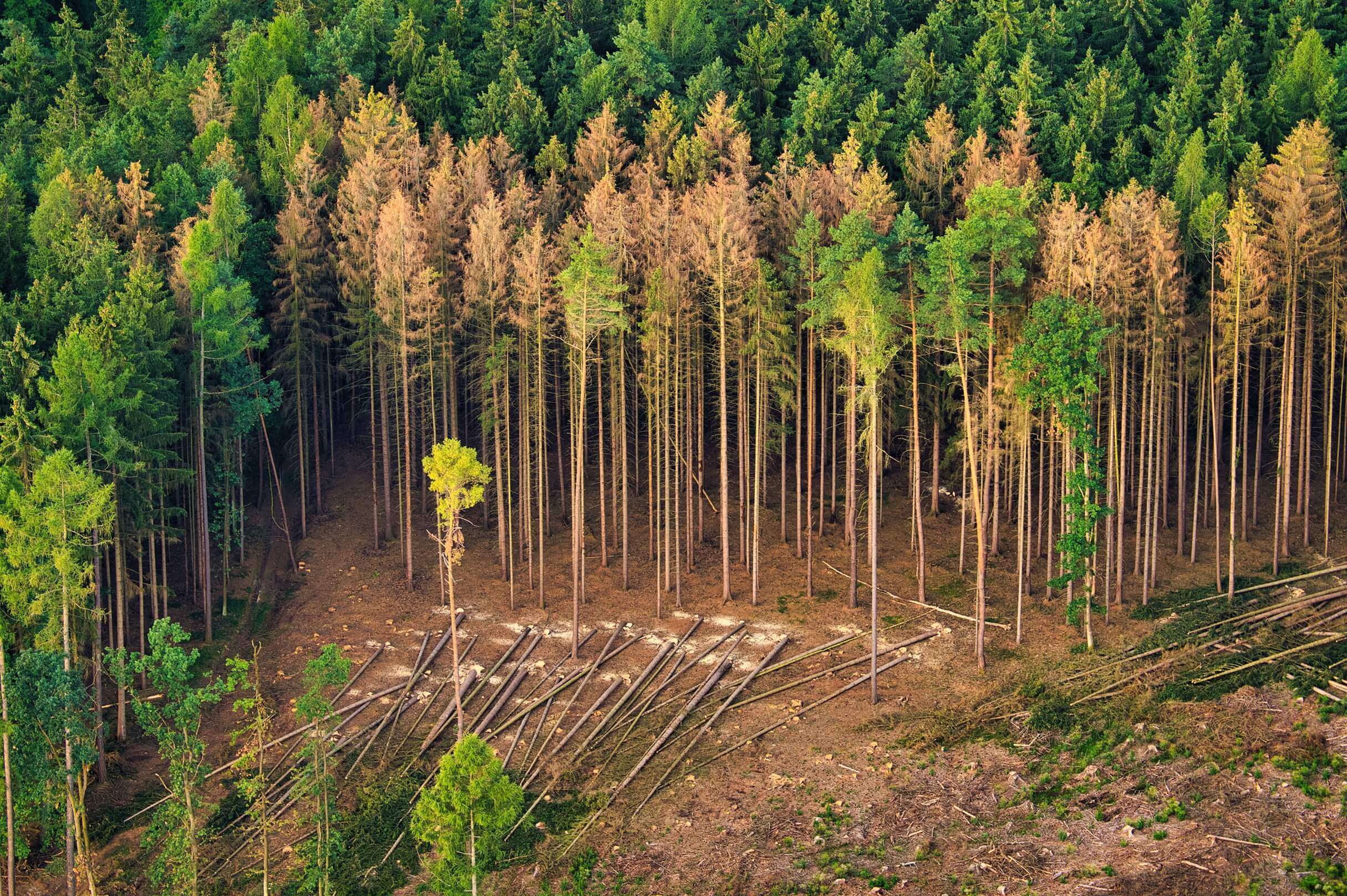
A forest owner walking their holding after a storm finds the obvious damage: the large swathes of windthrown timber, the red crowns on damaged spruce along the road. What they miss is the scattered attacks further in — the isolated tree on a slope that stood wrong to the wind, the early attacks in a stand that still looks healthy from a distance. According to Jacob Hjalmarsson, co-founder of Arboair and the person behind the analysis models that survey Swedish forests from the air every day, it is precisely this hidden damage that makes bark beetle attack an economic problem of an entirely different magnitude than most landowners expect.
"What we often see is that people know there is damage where they know there is damage," says Hjalmarsson. "But they don't know what they are missing. If you don't look across the whole holding, you often miss more than half of all the damage. And even with a field inventory, you miss between twenty and forty per cent of all damaged trees."
Mapping bark beetle damage: the visible and the invisible
The bark beetle — above all the spruce bark beetle, Ips typographus — is part of the natural cycle of the forest ecosystem. Under normal conditions, populations are stable. What changes the equation is a combination of factors: dry, warm summers that stress spruce and lower its resistance, and windthrown timber that offers an undisturbed breeding site without equal.
A standing spruce is not defenceless. Resin channels run beneath the bark, and when a bark beetle tries to bore in it is met by a flow of resin that can drown the insect and plug the entry hole. A young, healthy spruce with good access to water has a functioning defence. An older spruce, or one stressed by drought, is more vulnerable. But a windthrown tree has no defence at all.
"It is like an open buffet for the bark beetle," Hjalmarsson describes. "You lay your eggs undisturbed under the bark and can eat your fill without the tree being able to do anything about it. That means a major storm sets off a biological process that can be hard to slow down unless you act fast."
Storm Dave and Storm Johannes struck parts of Sweden with brutal effect during 2024, and 2025 looks in advance like a season with early warm weather. The combination of abundant windthrow and high temperatures is exactly the conditions under which population explosions occur.
What the law requires of the landowner
The Swedish Forestry Act is clear on this point: after a storm or attack, damaged and windthrown timber must be removed from the forest. The limit is set at five cubic metres per hectare of felled or infested timber, and the responsibility for complying with the legislation rests with the landowner.
The reasoning is simple. The more infested timber left in place, the more generations of bark beetles can be produced and spread to the surrounding standing forest. Leaving windthrow in place is not only an economic loss for the individual landowner; it is also a risk to the neighbours' forests.
But Hjalmarsson is clear that the five-cubic-metre limit is no guarantee. "Five cubic metres can be too much depending on the situation. Locally you may need to get down even lower to really slow the spread." That presupposes you actually know where the infested timber is — and it is precisely that knowledge which traditional inventory does not reliably provide.
What it actually costs
Take a forest owner with a hundred hectares of productive forest land. In a bark beetle outbreak affecting one to two per cent of the holding, that amounts to roughly 350 to 700 cubic metres of timber at risk. Counting SEK 800 per cubic metre for spruce timber, that is a timber value of SEK 280,000 in the worst-affected trees.
The problem is not the trees you find. It is the ones you don't.
If a traditional field inventory misses twenty per cent of the damaged trees on that property, it means 70 cubic metres with active attacks are left untouched. Those trees produce the next generation of bark beetles. In warm weather the population can grow five to ten times in a single season. The 70 cubic metres you missed this spring may, in an unfavourable scenario, have generated 350 to 700 cubic metres of new damage by next summer. That is another SEK 280,000 in lost value, and the bill starts over.
"It is the cumulative effect that is dangerous," says Hjalmarsson. "You always clean up the worst of it and think you have control. But beneath the surface there is an underlying spread you never see until it is too late."
How aerial inventory changes the equation
What Arboair does is fly drones over the forest holding and capture imagery at a resolution of two to three centimetres per pixel. That is a difference from satellite data at ten-metre resolution which is hard to overstate: that density of information is what allows the AI to make distinctions that are impossible from space.
"Our AI can tell the difference between healthy trees, damaged trees and dead trees," Hjalmarsson explains. "It works for pine too, not just spruce. And we can quickly find all the windthrow and stem breakage in a forest, which are critical findings for protecting the standing forest."
An analysis of a hundred hectares costs roughly SEK 6,000 including data collection. If the landowner can fly their own drone data, the cost can be pushed down to SEK 2,290. Relative to the value an undetected bark beetle population can destroy in a single season, that is an investment with a clear calculation.
From map to decision
An aerial inventory gives more than a list of damaged trees. It gives a priority order. Which stands are worth acting on and which are not? Which windthrow falls within the limits the Forestry Act requires you to deal with? Where are the early attacks that are not yet clearly visible but that sit in the direction of healthy forest?
"You can see immediately which areas have to be removed under the law and which are profitable to extract," says Hjalmarsson. "And if you analyse over time you get a good picture of how the spread is moving across the property. Then you can start planning the forest to become more resilient, not just react."
At bottom, it is about changing your position in relation to the damage. Moving from dealing with what you happen to find by accident, to having an actual map of what is going on and what is about to happen.
Storm Dave and Storm Johannes left timber in the forest. The coming warm season gives the bark beetle ideal conditions. For the forest owner who decides this year to survey the entire holding, not just the obvious swathes, the question is not whether there is more damage than they know about. The question is how much more.